The New U.S. Regulatory Framework for Digital Assets and the Legal Status of Major Cryptocurrencies
3-Point Summary
- U.S. regulators classify digital assets based on function, structure, and sale method rather than token “form.”
- BTC and ETH are effectively treated as digital commodities, while most L1s function as commodities or tools but may have security-like initial sales.
- For RWA tokens, the combination of the underlying asset and the issuance/sale structure determines whether they are treated as securities.

50-Second Shorts Video
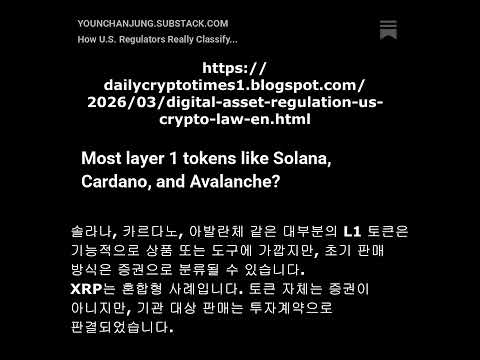
Use this 50-second video to grasp the overall regulatory landscape before diving into the full breakdown below.
How U.S. Regulators View Digital Assets and the Legal Landscape for Major Coins
From SEC/CFTC Classification → Security Analysis → RWA Structure → Major Coin Categories in One View
As the digital asset market rapidly expands its connection with traditional finance, a key question has emerged: how U.S. regulators classify digital assets and what criteria they use to determine whether a token is a security. Below is a structured summary of the core points.
📌 Key Takeaways
- U.S. regulators focus more on a token’s function, structure, and sale method than on its “form.”
- BTC and ETH are effectively treated as digital commodities (non‑securities).
- L1 tokens are generally commodities or tools, though their initial sales can be treated as securities.
- XRP has a mixed structure.
- Stablecoins are generally treated as non‑securities.
- For RWA tokens, the combination of the underlying asset and the issuance/sale structure determines whether they are securities.
1. SEC and CFTC classification of digital assets
U.S. regulators classify digital assets based on their functions and structural characteristics as follows.
Digital asset classification flow
1) Identify the asset’s actual function
- Is it fundamental to network operation?
- Is it primarily for collection or in‑app use?
- Does it perform a practical, utilitarian function?
2) Classify based on function
Commodity / Collectible / Tool / Stablecoin / Security
3) Determine the applicable regulatory framework for each category
Key categories
Digital Commodities
Assets whose value is determined by programmatic network operation and market supply–demand dynamics (e.g., BTC).
Digital Collectibles
Assets intended for collection or use, such as digital art or in‑game items.
Digital Tools
Tokens that provide practical utility, such as memberships, tickets, or certifications.
Stablecoins
Treated as non‑securities when they meet the criteria under the GENIUS Act.
Digital Securities
Assets that represent traditional financial products (stocks, bonds, funds, etc.) in tokenized form.
2. Criteria for applying U.S. securities law
Whether a digital asset is a security is assessed using the Howey Test.
The four elements of the Howey Test
- Investment of money
- In a common enterprise
- With the efforts of others being essential
- With a reasonable expectation of profit
The SEC clarifies the following:
- Even a non‑security asset can be treated as a security if the sale involves a “promise of profit” plus “the issuer’s essential managerial efforts.”
- If a network becomes sufficiently decentralized, the asset can move out of “investment contract” status.
In other words, the method of sale matters more than the token’s outward form.
3. How non‑tokenized‑security RWA tokens are treated
RWA (Real‑World Asset) tokens can broadly be divided into two categories.
① Tokenized securities → Clearly securities
This refers to tokenizing existing financial instruments such as stocks, bonds, or fund shares.
② Tokenized non‑security real‑world assets → No dedicated category
If the underlying asset is not a security—such as gold, art, real‑estate usage rights, or carbon credits—the token can be treated as a non‑security.
However, if certain conditions are met, the token can be reclassified as a security.
Framework for assessing whether an RWA token is a security
1) Identify the nature of the underlying asset
- Is it a security?
- Is it a physical real‑world asset?
- Is it a rights certificate or entitlement?
2) Analyze the issuance and sale structure
- Is there a promise of returns or yield?
- Are the issuer’s managerial efforts essential to generating value?
- Is it structured as a common enterprise for investment purposes?
3) Final determination
- Does it constitute an investment contract (security)?
- Or is it a non‑security asset?
In short, for RWA tokens, the combination of the underlying asset and the issuance/sale structure determines whether they are treated as securities.
4. Regulatory classification of major coins (combined SEC/CFTC view)
Below is a snapshot of how major coins are generally viewed from a regulatory perspective.
📊 Regulatory classification of major coins
[BTC]
Classification: Digital Commodity
Note: Fully decentralized with no issuer or central operator. The CFTC clearly treats it as a commodity.
[ETH]
Classification: Very high likelihood of being treated as a Digital Commodity
Note: The network operates functionally, and value arises from demand, supply, and usage. Despite internal debate at the SEC, recent trends lean toward treating ETH as a commodity.
[SOL / ADA / AVAX and other L1s]
Classification: Commodity or Tool
Note: The networks themselves are functional, but initial sales (e.g., ICOs) may be classified as investment contracts. There is significant room to interpret the assets themselves as non‑securities.
[XRP]
Classification: Mixed structure
Note: The asset itself has been ruled a non‑security, but institutional sales have been recognized as investment contracts. Regulatory treatment therefore varies depending on how it is sold.
[USDT / USDC]
Classification: Non‑securities
Note: As payment and remittance‑focused stablecoins, they contain little to no investment‑contract elements. Regulation focuses mainly on the issuer, reserve transparency, and risk management.
🎯 Final summary
- U.S. regulators focus on a token’s function, structure, and sale method rather than its outward “form.”
- BTC and ETH are effectively treated as digital commodities.
- Most L1 tokens are viewed as commodities or tools, though their initial sales can be treated as securities.
- XRP exhibits a mixed structure.
- Stablecoins are generally treated as non‑securities.
- For RWA tokens, the combination of the underlying asset and the issuance/sale structure determines security status.
These classifications are likely to be a key factor shaping how quickly digital assets are integrated into the regulated financial system after 2026.
Younchan Jung
Researcher exploring structural shifts in AI, blockchain, and the on‑chain economy.
If you would like to read this article in Korean, please click the button below.


댓글
댓글 쓰기