From ETFs to 401(k)s: How Crypto Could Enter the U.S. Retirement Market
3-Point Summary
- After ETF approvals, crypto’s next major entry point may be the U.S. 401(k) system—the largest pool of long-term capital.
- The DOL’s proposed rule would allow crypto and alternative assets in 401(k)s, creating a legal framework and safe harbor for fiduciaries.
- If adopted, the rule could shift crypto from short-term speculative flows to long-term structural allocation within retirement plans.

50-Second Shorts Video
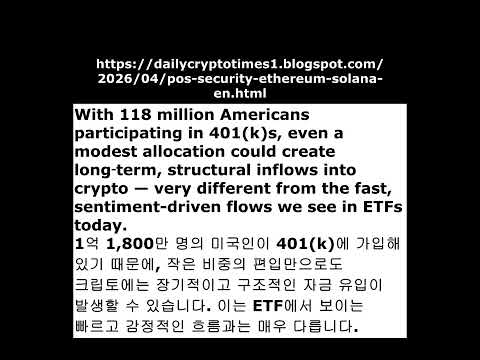
Watch the 50-second video to understand today’s topic before diving into the full analysis below.
From ETFs to 401(k)s: How Crypto Could Enter the US Retirement Market
After ETFs, the next frontier for crypto may be America’s largest pool of long-term capital: 401(k)s.
The U.S. Department of Labor (DOL) has proposed a new rule that would allow crypto and alternative assets to be included in 401(k) retirement plans. This doesn’t mean crypto will be automatically added to every plan. Instead, it signals an intent to create a legal framework and safe harbor for plan fiduciaries who want to offer crypto exposure under strict conditions.
In the wake of spot Bitcoin and Ethereum ETF approvals, this proposal could quietly reshape how the retirement system interacts with digital assets—and how long-term capital flows into crypto.
1. Why is this rule emerging now?
① The post-ETF shift toward full institutionalization
With Bitcoin and Ethereum ETFs now trading on major U.S. exchanges, institutional access to crypto has become far easier.
Once the SEC opened the door via ETFs, it was only a matter of time before the DOL had to confront the question:
Should retirement plans also be allowed to touch this asset class—under controlled conditions?
② Performance pressure inside the retirement system
The U.S. 401(k) system covers roughly 118 million Americans and around $8.8 trillion in assets.
Traditional portfolios built only from stocks and bonds are under growing pressure to deliver long-term returns in a world of inflation, rate cycles, and structural shifts.
That has fueled a steady push toward alternative assets.
③ The broader trend toward alternative asset inclusion
Some retirement plans already include exposure to real estate, private equity, or infrastructure.
In that context, crypto is increasingly seen not as a fringe speculation, but as the next candidate in the alternative asset toolkit.
➡️ ETF approvals → institutional normalization → retirement return pressure → demand for alternatives These forces together set the stage for the DOL’s proposed rule.
2. How do BTC/ETH ETFs work, and how is 401(k) exposure different?
① How BTC and ETH ETFs operate
ETF issuers directly hold the underlying assets.
- Bitcoin ETFs → hold actual BTC
- Ethereum ETFs → hold actual ETH
- Custody is handled by regulated custodians
- The ETF price tracks the underlying asset’s market price
➡️ An ETF is a structure that directly owns and manages the crypto on behalf of investors.
② How 401(k) exposure would work under the DOL rule
401(k) plan sponsors and fiduciaries would not be directly buying, holding, or staking crypto. Instead, they would be allowed to offer crypto exposure as an investment option within the plan, under strict due diligence and suitability standards.
1) Adding BTC/ETH ETFs to the 401(k) investment menu
The most realistic and regulator-friendly path is simple:
plan sponsors list spot Bitcoin or Ethereum ETFs as optional investments that participants can choose.
2) Offering multi-asset funds that include a crypto allocation
For example:
- 90% equities + 10% Bitcoin ETF
- 80% bonds + 20% Ethereum ETF
In this model, crypto is just one slice of a diversified fund, rather than a standalone, high-volatility bet.
➡️ 401(k) plans would provide indirect crypto exposure via ETFs or funds, not by holding coins directly.
3. How does the “wealth-building” mechanism differ?
| Category | BTC/ETH ETFs | 401(k) (if DOL rule is adopted) |
|---|---|---|
| Asset holding | Directly holds BTC/ETH | Holds ETFs or funds that include crypto |
| Return mechanism | Crypto price ↑ → ETF price ↑ | Plan value reflects ETF/fund performance |
| Management style | Issuer manages buys, custody, rebalancing | Plan fiduciaries choose products and allocations |
| Capital profile | Short- to medium-term, easily traded | Long-term, auto-contributed, “sticky” capital |
| Risk oversight | ETF issuer and regulators | Plan fiduciaries under DOL standards |
➡️ ETFs are a direct investment wrapper; 401(k)s are a long-term, indirect access channel.
4. What happens if the rule is finalized?
① Different capital behavior: ETF flows vs. 401(k) flows
ETF flows can be fast, tactical, and sentiment-driven.
401(k) flows are the opposite: automatic, periodic, and long-term.
Once crypto exposure is embedded in target-date funds or allocation models, it becomes part of a slow, persistent capital stream.
② Potential for meaningful long-term inflows
Even if only a small fraction of 118 million participants gain indirect crypto exposure,
the cumulative effect over years or decades could be substantial.
This isn’t about a single “pump” event—it’s about structural demand.
③ Possible dampening of volatility
Because 401(k) allocations are not typically traded in and out based on daily sentiment,
they could act as a stabilizing force, smoothing some of the extreme short-term volatility that has defined crypto markets so far.
➡️ ETFs may drive short-term price shocks; 401(k)s could underpin long-term market depth and resilience.
Conclusion: A quiet but powerful next step for crypto in the real economy
The DOL’s proposal is not a promise that every American retirement plan will soon hold Bitcoin or Ethereum. It is, however, a clear signal: crypto is being considered within the same regulatory and fiduciary frameworks that govern the core of the U.S. retirement system.
If ETF approvals marked the moment crypto entered the front door of Wall Street, a finalized 401(k) rule would mark the moment it quietly stepped into the long-term savings of ordinary workers.
Whether or not this specific proposal is adopted in its current form, the direction of travel is clear: crypto is moving from speculative trade to structural allocation.
Younchan Jung
Researcher exploring structural shifts in AI, blockchain, and the on‑chain economy.
If you would like to read this article in Korean, please click the button below.


댓글
댓글 쓰기