Tokenized Treasuries, MMFs, and Deposit Tokens: The Three Core Pillars of Institutional On‑Chain Finance
3-Point Summary
- Tokenized Treasuries and MMFs serve as institutional investment assets, primarily utilizing public or hybrid blockchain architectures.
- Deposit Tokens function as the "on-chain cash" layer, enabling 24/7 real-time settlement within permissioned banking networks.
- The integration of these three pillars through atomic settlement is defining the new core infrastructure for institutional finance.

50-Second Shorts Video
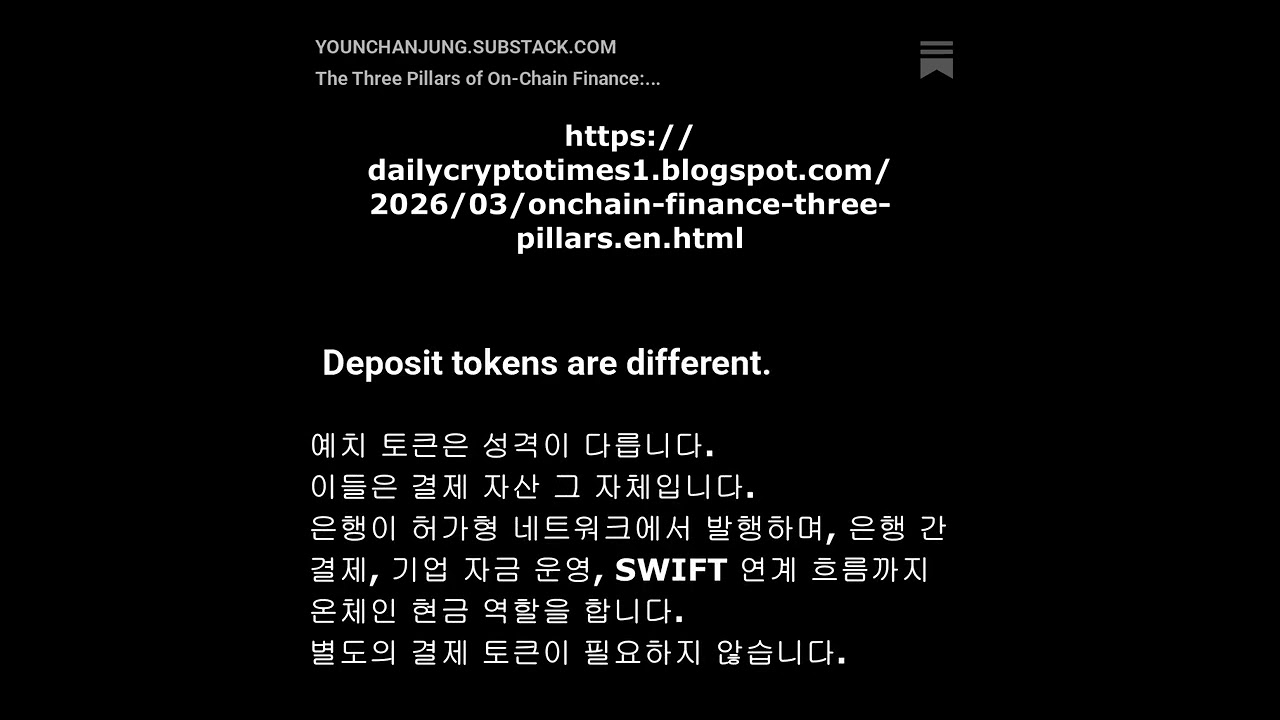
Watch this 50-second breakdown before diving into the full analysis below.
Inside the Lifecycle of Tokenized Treasuries, MMFs, and Deposit Tokens
RWA tokenization is no longer a mere experiment; it is rapidly becoming core infrastructure for institutional finance. Among them, tokenized treasuries, MMFs, and deposit tokens are emerging as the three key pillars that structure the new on-chain financial layer.
- Tokenized Treasuries: Regulation-friendly, collateral-first, institution-centric
- Tokenized MMFs: Stable short-term liquidity, strong demand from corporates and insurers
- Deposit Tokens: Settlement-focused, core to bank and SWIFT infrastructure
All three assets live on blockchain rails for trading, settlement, and collateralization, but the way they operate on-chain differs significantly depending on their economic role. Below is a structured look at the lifecycle of each asset.
1) Tokenized Treasuries
Tokenized treasuries are the first RWA that institutional investors have adopted at scale. They combine regulatory friendliness, credit quality, and collateral utility in a single instrument.
Lifecycle Overview
Issuance (Off-chain)
The U.S. Treasury issues government bonds, and a custodian holds the underlying securities.
Tokenization (On-chain)
The custodian mints tokens that represent the underlying treasuries on a 1:1 basis.
Both public chains (e.g., Ethereum) and permissioned networks are used.
Trading (On-chain)
Institutions and corporates buy and hold tokenized treasuries in on-chain wallets.
Collateralization (On-chain)
Used as collateral in repo, derivatives margining, and services like TCN or Citi Token Services.
These flows are typically handled on permissioned networks.
Settlement (On-chain)
Tokenized treasuries are investment assets, so they do not function as money.
Settlement therefore occurs via an exchange between
treasury tokens ↔ deposit tokens or stablecoins.
This is executed through atomic settlement, where both legs of the trade
(assets and payment tokens) move simultaneously, eliminating settlement risk and enabling 24/7 trading.
Deposit tokens and stablecoins effectively act as “on-chain cash” in this process.
Redemption (On-chain + Off-chain)
At maturity, the underlying treasuries are redeemed off-chain, and the corresponding tokens are burned on-chain.
Tokenized treasuries are a prime example of hybrid architectures that combine public and permissioned blockchains.
2) Tokenized Money Market Funds (MMFs)
Tokenized MMFs are the on-chain version of short-term liquidity management. They are particularly attractive to corporate treasuries, insurers, and other institutions seeking stable yield.
Lifecycle Overview
Issuance (Off-chain)
An asset manager constructs the MMF portfolio off-chain.
Tokenization (On-chain)
Fund shares are issued as ERC‑20 or similar tokens.
These are primarily deployed on public chains such as Ethereum.
Trading (On-chain)
Corporate treasuries and institutions purchase and hold MMF tokens on-chain.
Collateralization (On-chain)
MMF tokens can be pledged as short-term liquidity collateral.
They can be used across both public and permissioned networks.
Settlement (On-chain)
Like treasuries, MMF tokens are investment assets and do not serve as a payment instrument.
Settlement therefore occurs via
MMF tokens ↔ deposit tokens or stablecoins.
Trades are executed at NAV-based prices, making them suitable for short-term liquidity management by corporates.
As with treasuries, a separate settlement token is essential for completing the transaction.
Redemption (On-chain + Off-chain)
Upon redemption, the underlying assets are settled off-chain, and the corresponding MMF tokens are burned on-chain.
As seen in examples like BNP Paribas’ tokenized MMFs, this asset class is expanding rapidly on public chains.
3) Deposit Tokens
Deposit tokens form the core settlement layer of on-chain finance. Banking and SWIFT infrastructure are increasingly being re-architected around this instrument.
Lifecycle Overview
Issuance (On-chain)
Banks issue deposit tokens on a 1:1 basis against customer deposits.
These tokens are almost exclusively deployed on permissioned networks.
Circulation (On-chain)
Used for interbank settlement and corporate treasury cash management.
Collateralization (On-chain)
Employed as collateral for derivatives margining and clearing.
A permissioned network is required due to regulatory and KYC/AML constraints.
Settlement (On-chain)
Deposit tokens are natively designed for settlement—they are effectively “on-chain cash.”
No separate payment asset is needed: settlement occurs directly via
deposit token ↔ deposit token transfers.
Interbank payments, corporate treasury flows, and even SWIFT-linked transactions can be processed in real time.
Because deposit tokens represent digital bank deposits on permissioned networks,
they enable true 24/7 settlement.
When integrated with SWIFT, they can also bridge to public chains like Ethereum,
connecting traditional and on-chain payment infrastructures.
Redemption (On-chain + Off-chain)
When a customer requests redemption, the deposit tokens are burned on-chain and cash is paid out off-chain.
Given the centrality of banking regulation, deposit tokens are predominantly operated on closed, permissioned blockchains.
In Summary
- Tokenized Treasuries: Public (Ethereum) + permissioned hybrid; require deposit tokens or stablecoins for settlement
- Tokenized MMFs: Primarily public; also require deposit tokens or stablecoins for settlement
- Deposit Tokens: Almost entirely permissioned; serve as the settlement asset itself, no separate payment token needed
Together, they form the architecture of institutional on‑chain finance: investment assets on public chains, settlement assets on permissioned networks, unified through atomic settlement flows.
Younchan Jung
Researcher exploring structural shifts in AI, blockchain, and the on‑chain economy.
If you would like to read this article in Korean, please click the button below.


댓글
댓글 쓰기