The Stablecoin Transformation: How the Genius Act Opens a New Financial Order
3-Point Summary
- The Genius Act establishes the first comprehensive U.S. framework that treats stablecoins as secure, regulated payment infrastructure.
- The bill mandates strict 1:1 reserve backing, monthly disclosures, quarterly audits, and potential real-time API-based transparency.
- It accelerates the shift toward on-chain financial infrastructure, including tokenized reserves and proof‑of‑reserves systems, marking the beginning of the digital dollar era.

50-Second Shorts Video
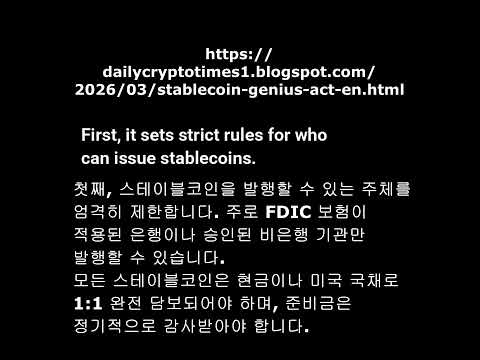
Watch the 50-second video to understand the Genius Act before diving into the full analysis below.
The Stablecoin Transformation: How the Genius Act Opens a New Financial Order
The United States Congress is advancing the Genius Act (Stablecoin Bill), a landmark proposal that is rapidly becoming one of the most important topics in global crypto and digital finance. This legislation goes far beyond simple crypto regulation — it represents the first serious attempt to institutionalize the digital evolution of the U.S. dollar. By strengthening stability, transparency, and compliance, the Genius Act lays the foundation for the future on-chain financial infrastructure.
Below is a clear and concise breakdown of the Genius Act’s core provisions, reserve reporting requirements, and the expansion of on-chain transparency.
1) Key Provisions of the Genius Act (Stablecoin Bill)
The Genius Act is the first comprehensive U.S. regulatory framework designed to bring stablecoins into the formal financial system. It treats stablecoins not as simple digital tokens, but as trusted and secure payment infrastructure.
Purpose of the Act
- Enhance stablecoin safety and transparency
- Strengthen financial system stability
- Protect consumers
- Improve global payment competitiveness
Issuer Requirements
- Only FDIC-insured banks may issue stablecoins
- Non-bank institutions may issue with Federal Reserve approval
- Issuers must demonstrate regulatory compliance capability
- Unlicensed issuance is prohibited
Reserve Requirements
- Mandatory 1:1 full reserve backing
- Permitted assets: cash, U.S. Treasuries, repo agreements
- Reserves must be segregated from issuer assets
- Regular external audits required
Regulatory Classification
- Not classified as securities or commodities under SEC/CFTC
- Not treated as bank deposits
- Stablecoins become an independent regulatory category
2) Reserve Reporting Requirements and Direction
The credibility of a stablecoin ultimately depends on whether its reserves truly exist. The Genius Act establishes a structured system for reporting, auditing, and public disclosure.
Monthly Reporting
- Total supply issued
- Total reserves held
- Reserve composition (cash, Treasuries, etc.)
- Reserve-to-supply ratio
Quarterly External Audits
- Audits conducted by PCAOB-registered firms
- Verification of reserve existence
- Confirmation of 1:1 backing
Potential Real-Time or Near Real-Time Disclosure
- API-based reserve balance disclosure
- Real-time updates of Treasury holdings
- Bank account balance verification systems
Direction of the Reporting Framework
- Greater transparency
- Consumer protection focus
- Increased issuer accountability
- Foundation for institutional participation
3) Expansion of On-Chain Transparency
Beyond reporting, the Genius Act points toward a future where real-time, blockchain-based transparency becomes the standard. This shift positions stablecoins as core infrastructure for global payments.
On-Chain Tokenization of Reserves
- Tokenization of Treasuries and cash-equivalent assets
- Public, verifiable reserve status
- Expansion into on-chain money market funds
On-Chain Proof of Reserves (PoR) — Chainlink Example
On-chain PoR enables direct verification of stablecoin reserves on the blockchain. The most widely adopted solution in this field is Chainlink Proof of Reserve.
- Oracle networks automatically fetch reserve data
- Updates are published on-chain in real time or at intervals
- Automated verification of 1:1 backing
- Used by major assets such as USDC, TUSD, and WBTC
Alignment with Global Regulation
- Similar direction to EU MiCA and Singapore MAS
- U.S. standards may become global benchmarks
- On-chain transparency becomes essential for international payments
Conclusion: The Genius Act Marks the Beginning of the Digital Dollar Era
The Genius Act is the first U.S. law designed to integrate stablecoins into the official financial system. Its reserve reporting and on-chain transparency requirements set the stage for a new global payment standard. Once enacted, stablecoins will evolve from simple crypto assets into the core rails of the digital dollar.
Current Status of the Genius Act
- Active discussions in both the Senate and House
- Bipartisan interest from lawmakers such as Lummis and Gillibrand
- Multiple statements suggesting a vote is approaching
- High likelihood of bipartisan agreement
Expected Timeline
- 2025–2026: High probability of passage
- Immediately after: Rapid expansion of stablecoin issuance
- 1–2 years: Banks and fintechs begin issuing stablecoins
- 2–5 years: On-chain dollar payments become a global standard
Younchan Jung
Researcher exploring structural shifts in AI, blockchain, and the on‑chain economy.
If you would like to read this article in Korean, please click the button below.


댓글
댓글 쓰기