The Great Transformation of Tokenized Finance: Explosive RWA Growth and the Era of Stablecoins
3-Point Summary
- RWA tokenization is accelerating, with Ethereum capturing 34% of the market and growing 315% in one year.
- Stablecoins are driving on-chain liquidity and forming the foundation of tokenized finance.
- Institutional products like MONY and BUIDL are creating a new on-chain liquidity layer.

50-Second Shorts Video
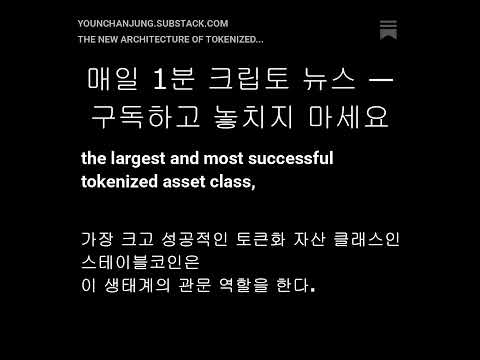
Watch this 50-second summary to understand the core shift before reading the full analysis.
The Great Transformation of Tokenized Finance: Explosive RWA Growth and the Rise of Stablecoins
Real World Asset (RWA) tokenization is no longer an experiment. It has become a structural shift reshaping global finance. Institutional adoption is accelerating, and Ethereum has emerged as the dominant chain—growing 315% in just one year and capturing 34% of the market. As the broader landscape shows, this transformation can be understood through five clear phases.
1. Stablecoins: The Starting Point of Tokenized Finance
Stablecoins are not simply “crypto.” They are tokenized representations of real-world assets such as cash, bank deposits, and U.S. Treasury bills.
They serve as:
- The base currency for on-chain payments
- The largest and most successful category within RWA
- The pricing and settlement foundation for all tokenized assets
As stablecoins grow, they expand on-chain liquidity, which in turn accelerates the RWA market. A powerful network effect is now in motion:
Stablecoin adoption → On-chain liquidity expansion → RWA market growth
2. The Acceleration of the RWA Tokenization Market
The RWA market is entering a hyper-growth phase.
- Ethereum-based RWA: $4.1B → $17B (315% growth)
- Institutional participation: BlackRock, JP Morgan, Wintermute, and more
- User growth: RWA holders up 34% in the past month
- Global outlook: $2T by 2028, $11T by 2030
RWA tokenization is no longer emerging—it is scaling at an exponential rate.
3. Ethereum Becomes the Institutional Standard Chain
Institutions are choosing Ethereum for reasons that are increasingly clear:
- Deep liquidity
- Mature and reliable infrastructure
- Strong security guarantees
- Regulatory familiarity and trust
Ethereum is becoming the foundational layer for RWA tokenization and the core infrastructure for institutional on-chain finance.
4. MONY & BUIDL: The Rise of Institutional On-Chain Liquidity Layers
Institutional financial products are now moving directly on-chain, marking a new phase in tokenized finance.
JP Morgan MONY — On-Chain Money Market Fund (MMF)
- Investors deposit USD or USDC → MONY tokens are issued
- Tokens are held directly in investor wallets
- Transfers allowed between approved wallets
- Tokens can be used as collateral
- NAV adjustments reflect yield
MONY proves that a regulated money market fund can operate directly on a public blockchain.
BlackRock BUIDL — On-Chain USD Liquidity Fund
- Investors deposit USD → BUIDL tokens are issued
- Tokens transferable 24/7
- Yield from T-bills, cash, and repos distributed automatically on-chain
BUIDL is a flagship example of bringing institutional-grade USD liquidity on-chain.
Together, MONY and BUIDL form a new institutional on-chain liquidity layer, setting the next standard for global financial infrastructure.
5. The Era of On-Chain Native Finance
All of these developments point toward a clear conclusion:
- Traditional financial products are being reborn as wallet-native, programmable, 24/7 instruments
- A new institutional liquidity layer is forming on public blockchains
- The structural transformation of global finance is accelerating
Finance is entering a blockchain-native era.
Conclusion
Stablecoins → RWA growth → Ethereum standardization → Institutional on-chain finance → On-chain native finance
This is not just a technological trend. It is the redesign of global financial infrastructure itself.
RWA tokenization is no longer optional—it is becoming the inevitable next stage of global finance.
Younchan Jung
Researcher exploring structural shifts in AI, blockchain, and the on‑chain economy.
If you would like to read this article in Korean, please click the button below.


댓글
댓글 쓰기