EIP‑8141 & ERC‑8211: Completing Ethereum’s Account & Execution Abstraction — A Core Upgrade for the AI Agent Era
3-Point Summary
- EIP‑8141 and ERC‑8211 are seen as the definitive completion of Ethereum’s account and execution abstraction.
- EIP‑8141 introduces frame-based transactions, enabling native atomic execution and protocol-level automation.
- ERC‑8211 standardizes multi-step DeFi execution and becomes core infrastructure for AI-driven on-chain agents.

50-Second Shorts Video
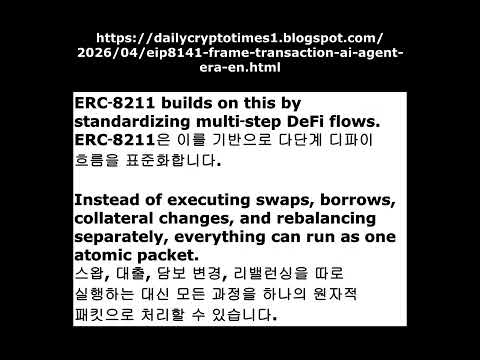
Watch the 50-second video to understand the core idea before diving into the full analysis below.
EIP‑8141 & ERC‑8211: The Completion of Ethereum AA and a Core Upgrade for the AI Era
For the past 10 years, Ethereum has been steadily evolving toward one major goal:
Account Abstraction (AA).
Smarter wallets, fewer clicks for users, and a protocol that can scale more flexibly — that has been the vision.
Now, two proposals have finally emerged at the center of this evolution:
EIP‑8141 and ERC‑8211.
These are not just incremental technical upgrades — they are widely seen as
“the definitive answer that ends a decade of AA debates.”
As the era of AI agents acting autonomously on-chain approaches, these two proposals are quickly becoming the core infrastructure that will determine Ethereum’s future competitiveness.
EIP‑8141 & ERC‑8211: Unified Evolution of Account & Execution Abstraction
1) EIP‑8141 — A decisive turning point for Account Abstraction
Previous approaches to Account Abstraction, such as ERC‑4337, enabled some features, but still relied heavily on external infrastructure like bundlers, relayers, and paymasters.
EIP‑8141 is the first model that addresses these issues
directly at the protocol level.
Its core innovation is a new transaction structure called
Frame Transactions.
“EIP‑8141 is the first proposal that makes Account Abstraction truly ‘Ethereum-native’.”
2) Structural limitations of the current transaction model — even more critical in the AI era
The current Ethereum transaction model is extremely simple:
- Single sender
- Single signature
- Single execution path
- Gas must always be paid in ETH by the sender
This simplicity brings stability, but it is far from sufficient for a world where AI agents act autonomously on-chain.
What AI agents need on-chain
- Atomic execution of multiple steps
- Full rollback guarantees when any step fails
- A standardized execution packet structure
- Predictable execution flow and gas usage
The current model does not natively support these requirements, which is why batch execution, sponsored transactions, and token-based gas payments have all relied on workarounds and off-protocol infrastructure.
3) Frame Transactions — the innovation of splitting a transaction into “frames”
EIP‑8141 structures a transaction as multiple frames, each with a specific role, executed in sequence.
Types of frames (concise version)
- Validation Frame — signature and custom validation logic
- Execution Frame — actual state changes and logic execution
- Deployment Frame — automatic account/contract creation
- Paymaster Frame — token-based gas payment (validation + settlement)
What this structure enables
- Custom signature schemes (multisig, key rotation, post-quantum signatures, etc.)
- Atomic batch execution (multiple calls as a single execution unit)
- Native support for sponsored and token-based gas payments at the protocol level
- Seamless integration of privacy features and automatic account deployment
Natural integration of smart account capabilities
The frame-based structure of EIP‑8141 removes the functional gap between EOAs and smart accounts, and provides a foundation where all accounts can natively support:
- Multisig and key rotation
- Post-quantum signatures
- Token-based gas payments and sponsored transactions
- Privacy-enhancing transactions and atomic batch execution
In other words, the boundary between EOAs and smart accounts disappears, and all accounts evolve toward a single, flexible framework.
4) EIP‑8141 ↔ ERC‑8211: Core infrastructure meets application-level standard
① EIP‑8141 = the base infrastructure for execution abstraction
EIP‑8141 introduces the concept of an Execution Packet, which bundles multiple calls into a single execution unit. This allows complex on-chain behavior to be executed atomically, and provides the foundation for autonomous behavior by AI agents and smart wallets.
“EIP‑8141 is like building the highway.”
② ERC‑8211 = the multi-step DeFi execution standard running on that highway
ERC‑8211 applies the execution model of EIP‑8141 specifically to DeFi transactions.
- Bundles complex flows like swap → borrow → collateral change → liquidation risk management
- Executes multiple steps as a single atomic transaction
- Reduces the complexity of event tracking and settlement logic
“ERC‑8211 becomes the ‘on-chain brain’ of AI agents.”
5) ERC‑8211 & AI agents — core infrastructure for on-chain automation
1) A standard for bundling multi-step DeFi flows into a single transaction
ERC‑8211 allows multiple DeFi operations — swaps, borrowing, collateral adjustments, rebalancing, liquidation risk management — to be bundled into a single execution packet and executed in one atomic transaction.
2) Better UX + reduced burden for developers
- Users can perform complex financial operations with “one click”
- Developers can simplify event mapping and settlement logic
- Backend complexity around cost calculation and event tracking is significantly reduced
3) Meeting the core requirements of AI agents
- Atomicity — if any step fails, the entire transaction rolls back
- Rollback safety — predictable failure handling
- Standardized execution packet structure
- Predictable execution flow and gas usage
Because of this, the community increasingly views ERC‑8211 as “the core infrastructure for AI-driven DeFi automation.”
4) Market impact — why this matters now
- If ERC‑8211 is adopted, the DeFi automation market could be fundamentally reshaped.
- AI trading bots and on-chain agent projects are likely to be the biggest beneficiaries.
- DeFi protocols may enter a new phase of competition around “single-transaction UX.”
📌 Final takeaways
- EIP‑8141 is the key proposal that completes Ethereum’s account & execution abstraction at the protocol level.
- ERC‑8211 is the application-level standard that builds on this foundation to standardize multi-step DeFi execution.
- In the AI agent era, ERC‑8211 will act as core infrastructure, opening the door to full on-chain automation.
- Together, these two proposals represent a technical turning point that could define the next decade of Ethereum.
Younchan Jung
Researcher exploring structural shifts in AI, blockchain, and the on‑chain economy.
If you would like to read this article in Korean, please click the button below.


댓글
댓글 쓰기