ETH/BTC Ratio 760:1 — The New Market Structure Shaped by Bitmine
3-Point Summary
- Bitmine now holds 4.04% of the total ETH supply, signaling a new phase of institutional Ethereum accumulation.
- Institutions use three distinct wallet structures — Treasury, Operational, and Validator — each serving different financial, operational, and security functions.
- ETH’s multi-layer utility across all three wallets drives a widening ETH/BTC value gap, while BTC remains a passive treasury-only asset.

50-Second Shorts Video
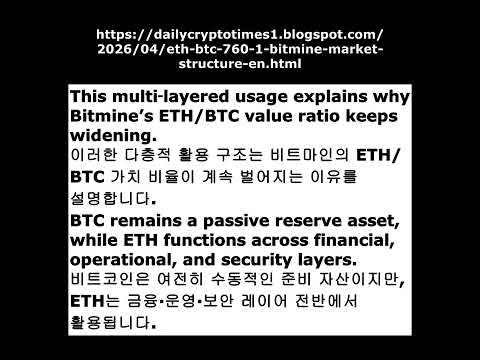
Watch the 50-second video to understand why institutional ETH accumulation matters before diving into the full analysis below.
Bitmine Surpasses 4.04% of Total ETH Supply
What institutional Ethereum accumulation means, and the three wallet structures they actually use
In the crypto market, the most important signal is not price, but who is accumulating and how much. Recently, CryptosRus reported the following:
“Bitmine has accumulated 71,524 more ETH, bringing their total to 4.87M — 4.04% of Ethereum’s total supply.”
A single company holding more than 4% of the total ETH supply indicates that institutional Ethereum accumulation has entered a strategic phase.
Bitmine’s ETH holdings are divided into three wallet structures:
- Treasury Wallet
- Operational Wallet
- Validator Wallet
1) Treasury Wallet — Long-term Corporate Reserve
Wallet Characteristics
- Very low transaction frequency
- Large-scale deposits and withdrawals
- Minimal protocol interaction
- Institutional-grade custody solutions
Monetization Methods
- Asset appreciation through long-term ETH holding
- Strengthening the corporate balance sheet
- Securing strategic liquidity
- Sending a long-term confidence signal to the market
Impact on the Ecosystem
- Reduced circulating supply, creating upward pressure
- Higher institutional confidence
- Greater price stability
- Reinforcement of long-term trust in Ethereum
2) Operational Wallet — On-chain Activity Wallet
Wallet Characteristics
- Moderate transaction frequency
- Active interaction with L2 networks
- Staking, LP, bridging, and other activities
- Clear protocol interaction traces
Monetization Methods
- Staking rewards (3–6%)
- Gas savings through L2 usage
- Liquidity provision revenue
- Protocol partnership-based income
Impact on the Ecosystem
- Acceleration of L2 ecosystem growth
- Enhanced network security through increased staking
- Reduced volatility through increased liquidity
- Higher ecosystem trust due to institutional participation
3) Validator Wallet — Network Security Participation
Wallet Characteristics
- Repeated 32 ETH deposits
- Unified withdrawal credentials
- Very low transaction frequency
- Long-term network participation
Monetization Methods
- Direct staking rewards (3–5%)
- MEV-Boost revenue
- Potential participation in EigenLayer AVS
- Enhanced credibility as an infrastructure operator
Impact on the Ecosystem
- Strengthened network security
- Reduced ETH circulating supply
- Activation of the MEV ecosystem
- Reinforcement of Ethereum’s economic security
Bitmine’s ETH/BTC Holdings and Current Value Comparison
(As of April 2026 — ETH $2,234.24 / BTC $72,323.10)
| Year | ETH Holdings | ETH Value (USD) | BTC Holdings | BTC Value (USD) | ETH/BTC Value Ratio |
|---|---|---|---|---|---|
| 2025 (Est.) | 3.0M ETH | $6.70B | 190 BTC | $13.7M | 489 : 1 |
| Q1 2026 | 4.66M ETH | $10.41B | 196 BTC | $14.17M | 735 : 1 |
| Mar 2026 | 4.732M ETH | $10.57B | 197 BTC | $14.25M | 742 : 1 |
| Apr 12, 2026 | 4.874M ETH | $10.89B | 198 BTC | $14.32M | 760 : 1 |
Why the ETH/BTC Ratio Continues to Widen
BTC Exists Only in the Treasury Wallet
BTC cannot participate in staking, validator operations, L2 or DeFi usage, or MEV extraction. It remains a passive reserve asset with limited strategic value.
ETH Is Used Across All Three Wallets
ETH is the core asset powering Bitmine’s financial, operational, and security layers.
- Treasury Wallet: Long-term holding and balance sheet strength
- Operational Wallet: Staking, L2, LP, partnerships
- Validator Wallet: Network security, MEV, EigenLayer
Result of ETH-Centric Strategy
ETH holdings increased by 1.87M in one year, while BTC remained nearly unchanged. This structural difference naturally widens the ETH/BTC value ratio.
Conclusion
Bitmine’s ETH accumulation is not simple hoarding. It is a structural strategy that leverages Ethereum’s financial, operational, and security layers. The widening ETH/BTC value ratio is the inevitable outcome of institutional Ethereum-centric strategies.
Younchan Jung
Researcher exploring structural shifts in AI, blockchain, and the on‑chain economy.
If you would like to read this article in Korean, please click the button below.


댓글
댓글 쓰기