From ETH Staking to RWA: The Six Forces Behind Ethereum’s $310B TVL
3-Point Summary
- Ethereum’s $310B TVL represents the combined value of staking, L1 DeFi, L2 networks, RWA, and stablecoin-based liquidity.
- Stablecoin supply is not counted directly in TVL, but deposited stablecoins form a core liquidity layer within DeFi.
- By 2027, staking growth, L2 expansion, RWA adoption, and LRT-driven liquidity are expected to push TVL toward $350B–$450B.

50-Second Shorts Video
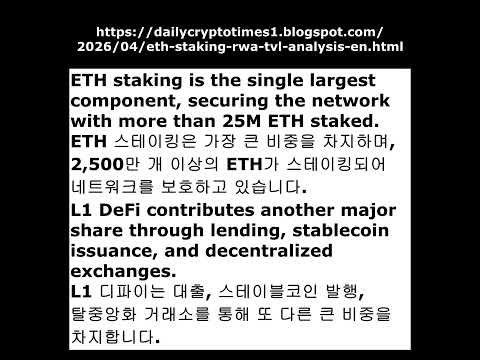
Watch the 50-second video to understand the Ethereum TVL breakdown before diving into the full analysis below.
Ethereum TVL 310B Full Breakdown: ETH Staking, L1, L2, RWA, and Ecosystem Composition
As of 2026, Ethereum has become the largest on-chain ecosystem with approximately $310B in Total Value Locked (TVL). TVL represents the total amount of assets actually deposited into smart contracts — a metric that reflects the real capital operating inside the on-chain financial system, rather than token supply or market capitalization. Through TVL, we can understand the liquidity, trust, economic scale, and growth dynamics of key sectors such as DeFi, L2 networks, and RWA.
Although the total supply of stablecoins (USDT, USDC, DAI, etc.) is not directly included in TVL, the portion deposited into smart contracts is counted as DeFi TVL. Understanding the difference between supply and deposited value is essential for interpreting Ethereum’s TVL structure.
This article provides a structured breakdown of how Ethereum’s $310B TVL is composed across staking, L1 DeFi, L2 networks, RWA, and stablecoin-based liquidity.
1. How Is Ethereum’s $310B TVL Structured? (6-Category Breakdown)
Ethereum’s total locked value is not a single pool but a combination of assets distributed across the entire ecosystem. Below is a high-level breakdown into six major categories.
① ETH Staking — $90B–$110B
ETH staking secures the Ethereum network and represents the largest share of total TVL.
- Includes Lido, Rocket Pool, and direct staking
- Over 25M ETH staked
- The single largest component of Ethereum TVL
② Ethereum L1 DeFi TVL — $60B–$80B
Core DeFi protocols operating on Ethereum mainnet, including lending, stablecoin issuance, DEXs, and asset management.
- Aave, MakerDAO, Curve, Uniswap
- Lending, DEX, stablecoin, and asset management protocols
③ Ethereum L2 Chain TVL — $30B–$40B
L2 networks are the backbone of Ethereum’s scalability, driving rapid TVL growth through lower fees and faster execution.
- Arbitrum, Optimism, Base, zkSync
- Core infrastructure for Ethereum’s scaling roadmap
④ RWA (Real-World Asset Tokenization) — $10B–$15B
Tokenized U.S. Treasuries, MMFs, gold, and other real-world assets — one of the fastest-growing sectors in 2026.
- On-chain tokenization of Treasuries, MMFs, gold
- Includes Ondo Finance, Pax Gold (PAXG)
⑤ Stablecoin-Backed DeFi TVL — $20B–$30B
Stablecoin supply is not counted directly in TVL, but the portion deposited into DeFi is a core liquidity layer for Ethereum.
- USDT liquidity pools
- USDC liquidity pools
- DAI collateral and lending pools
- Curve stablecoin pools
- Aave stablecoin lending pools
⑥ Other Ecosystem Capital — $60B–$80B
Includes bridge deposits, derivatives protocols, LST/LRT liquidity, and institutional on-chain assets — all structural capital flows outside L1/L2/DeFi/RWA.
- Bridge deposits (L1-locked assets for L2 transfers)
- Derivatives protocols (futures, options, leverage collateral)
- LST (Liquid Staking Tokens)
- LRT (Liquid Restaking Tokens)
- Institutional on-chain assets (Treasuries, cash-like assets, custody)
📊 Summary: Ethereum TVL 310B Breakdown
| Category | Estimated Size |
| ETH Staking | $90B–$110B |
| L1 DeFi | $60B–$80B |
| L2 Chains | $30B–$40B |
| RWA | $10B–$15B |
| Stablecoin-Based DeFi | $20B–$30B |
| Other Ecosystem Capital | $60B–$80B |
| Total | ≈ $310B |
2. Major Ethereum Applications + TVL Overview
1) DeFi (Decentralized Finance)
The core foundation of Ethereum’s TVL.
- Aave — Lending & borrowing → TVL: ~$24B
- Uniswap — Decentralized exchange → TVL: ~$5B
- MakerDAO — DAI stablecoin issuer → TVL: ~$6B
- Curve — Stablecoin-focused DEX → TVL: ~$2B
- GMX — Derivatives & perpetuals (Arbitrum) → TVL: ~$0.6B
2) NFT
NFT marketplaces do not use TVL as a metric because assets are not locked in smart contracts. Key metrics include trading volume, active users, and creator activity.
3) GameFi
GameFi ecosystems circulate assets through gameplay rather than locking them, so TVL is not a primary metric.
4) DAO
DAOs govern protocols but do not directly hold TVL. TVL remains within each protocol’s smart contracts.
5) Infrastructure
- Arbitrum — L2 → Chain TVL: ~$12B
- Optimism — L2 → Chain TVL: ~$7B
- Chainlink — Oracle network (no TVL metric)
6) Social Protocols
Social networks like Farcaster and Lens do not rely on TVL; their core metrics are active users, posts, and graph expansion.
7) RWA
- Ondo Finance — Tokenized Treasuries/MMFs → TVL: ~$1.5B
- Pax Gold (PAXG) — Tokenized gold → TVL: ~$0.5B
8) Privacy
- Aztec — Privacy-focused L2 → TVL: ~$20M
3. 2026 TVL Status & 2027 TVL Forecast
Ethereum’s $310B TVL is not just a snapshot of current capital — it is a forward-looking indicator of how large on-chain finance may become. While 2026 marks a maturing phase, 2027 is expected to bring another wave of expansion driven by staking, L2 growth, RWA, and LRT.
① ETH Staking
2026: $90B–$110B → 2027 forecast: $120B–$150B
② L1 DeFi
2026: $60B–$80B → 2027 forecast: $80B–$110B
③ L2 Chains
2026: $30B–$40B → 2027 forecast: $50B–$70B
④ RWA
2026: $10B–$15B → 2027 forecast: $25B–$40B
⑤ Stablecoin-Based DeFi
2026: $20B–$30B → 2027 forecast: $30B–$45B
⑥ Other Ecosystem Capital
2026: $60B–$80B → 2027 forecast: $70B–$100B
Total 2027 TVL Projection: $350B–$450B
4. Conclusion: Ethereum’s $310B TVL Represents the Entire On-Chain Economy
Ethereum’s $310B TVL is not merely a sum of DeFi deposits — it is the combined value of staking, L1 DeFi, L2 networks, RWA, bridges, stablecoin-backed liquidity, derivatives, LST/LRT, and institutional assets. It reflects the scale and maturity of the entire on-chain economy.
Stablecoins, while not directly counted in TVL, become a core component the moment they are deposited into DeFi. They are the liquidity foundation supporting Ethereum’s TVL growth.
By 2027, rising staking participation, L2 expansion, RWA adoption, LRT-driven multi-layered deposits, and institutional inflows are expected to strengthen Ethereum’s position as the global hub of on-chain finance.
In summary, Ethereum’s $310B TVL is not just a number — it is a measure of the entire on-chain economy and a clear indicator of where the future of financial infrastructure is heading.
Younchan Jung
Researcher exploring structural shifts in AI, blockchain, and the on‑chain economy.
If you would like to read this article in Korean, please click the button below.


댓글
댓글 쓰기