Ethereum’s Three Mega Cycles Over 10 Years: 227x, 54x, and How High Could the Next One Go
3-Point Summary
- Ethereum has experienced three fundamentally different mega cycles, each driven by a unique economic engine.
- The first two cycles were powered by crypto‑native demand (ICO, DeFi, NFTs), while the third cycle is driven by real‑world finance, AI, and institutional adoption.
- The 2024–2030 cycle may become the most structural and long‑lasting, supported by RWA tokenization, stablecoin globalization, L2 scaling, and ETH’s declining net supply.

50-Second Shorts Video
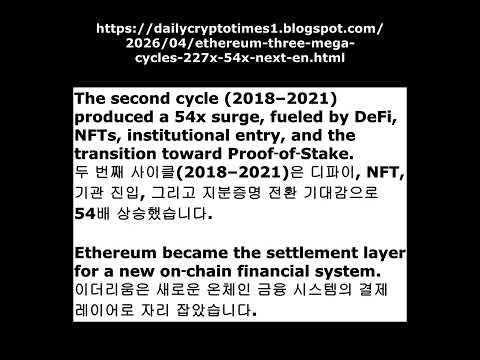
Watch the 50-second video for a quick breakdown of Ethereum’s three mega cycles before diving into the full analysis below.
Ethereum’s Three Mega Cycles
The cryptocurrency market has grown through repeated cycles, but not all cycles are created in the same way. Ethereum, in particular, has experienced three massive and fundamentally different surges over the past decade.
The first cycle delivered a 227x increase, the second a 54x increase. And now, we stand at the beginning of the third cycle — one that is structurally different from anything before.
To understand the true meaning of these three cycles, we must answer several key questions:
- What structural forces created the first 227x surge?
- Why did the second 54x surge explode in a completely different way?
- Why is the 2024–2030 cycle fundamentally different?
- Which indicators can help us measure the strength of this new cycle?
This article addresses exactly those questions. It organizes Ethereum’s three cycles into a single coherent narrative and explains why the third cycle we are entering now may be the most structural and long‑lasting of them all.
1) The Five Core Drivers Behind the First 227x Surge
(2015–2017 Sideways → 2017 Explosion)
From 2015 to 2017, Ethereum was recognized for its technical potential but lacked real-world use cases. The price moved sideways for a long period, and the market questioned whether Ethereum had any practical purpose.
But in 2017, everything changed. A major real-world use case emerged inside the Ethereum ecosystem. The ICO boom triggered an explosive surge in ETH demand, pushing Ethereum into its first mega cycle.
1. ICO Boom — Ethereum’s First Killer Use Case
With the introduction of the ERC‑20 standard, hundreds of projects issued tokens on Ethereum. Participation in ICOs required ETH, causing demand to skyrocket.
2. Smart Contract Platform Innovation
If Bitcoin was “digital gold,” Ethereum became the first general-purpose platform for decentralized applications (DApps). Developer adoption surged, accelerating network effects.
3. Rapid Expansion of Global Exchange Listings
Between 2016 and 2017, ETH was listed on major exchanges worldwide, dramatically increasing liquidity and accessibility.
4. Narrative of Technical Superiority Over Bitcoin
“Bitcoin is slow and simple; Ethereum is programmable and scalable.” This narrative attracted massive inflows of capital.
5. The First Global Crypto Mega Cycle
2017 marked the first major crypto bubble. Exploding public interest and new investor inflows accelerated ETH’s rise.
Result: Approximately 227x increase
2) The Six Core Drivers Behind the Second 54x Surge
(2018–2020 Sideways → 2020–2021 Mega Rally)
After the first cycle, Ethereum entered another long sideways phase from 2018 to 2020. The ICO bubble burst, regulatory uncertainty grew, and technical limitations became apparent.
But beneath the surface, a completely new financial ecosystem was quietly forming. In 2020, it exploded — and Ethereum recorded its second mega surge, rising 54x.
1. DeFi Boom — Ethereum’s Second Killer Use Case
Protocols like Uniswap, Aave, and MakerDAO grew rapidly. ETH became core collateral, and TVL surged into the billions.
2. Mainstream Adoption of NFTs
Collections like CryptoPunks and BAYC triggered massive demand for ETH as a settlement asset.
3. Institutional Capital Entering Ethereum
CME ETH futures and the Grayscale ETH Trust marked the first wave of institutional recognition.
4. Anticipation of Ethereum 2.0 (PoS Transition)
The launch of the Beacon Chain signaled the beginning of the shift to Proof‑of‑Stake, increasing staking demand and reducing expected supply.
5. Global Liquidity Explosion After COVID‑19
Zero interest rates and quantitative easing fueled a massive risk‑asset rally.
6. All‑Time High Network Usage
DeFi, NFTs, and staking combined to push gas fees and transaction demand to record levels.
Result: Approximately 54x increase
3) Drivers of the 2024–2030 Cycle
Seven Structural Changes Unlike Any Previous Cycle
The first two cycles were driven by internal crypto-native demand (ICO, DeFi, NFTs). But the third cycle is different: real-world finance, AI, and institutional infrastructure are moving on‑chain for the first time.
1. Large‑Scale Tokenization of Real‑World Assets (RWA)
BlackRock, Citi, and JP Morgan are building tokenization platforms on Ethereum.
2. Globalization of Stablecoin Payments
USDC and USDT are increasingly used for remittances, emerging‑market payments, and B2B settlement — positioning Ethereum as global dollar infrastructure.
3. Agentic AI × On‑Chain Economy
AI agents will execute payments and contracts directly on‑chain. Ethereum becomes the financial backend for autonomous AI systems.
4. Rise of On‑Chain Equities
Products like BlackRock’s BUIDL fund signal a future where securities and ETFs trade directly on Ethereum.
5. Maturation of Layer‑2 Scaling
Optimism, Arbitrum, Base, and zkSync now enable Ethereum to support mass‑market usage for the first time.
6. Structural Supply Reduction (EIP‑1559 + PoS)
ETH has entered periods of net negative issuance. Demand rising while supply falls creates long‑term upward pressure.
7. Regulatory Clarity + Potential ETH ETF Approval
Following Bitcoin ETFs, Ethereum ETFs could unlock major institutional inflows.
Conclusion: Why the Third Cycle Is the Most Promising
The first two cycles were driven by crypto‑native forces. The third cycle is driven by the transformation of the global financial system itself.
This is not just another price rally — it is a paradigm shift in financial infrastructure.
Why This Cycle Is Especially Promising
- Traditional financial institutions are moving directly onto Ethereum
- AI becomes a new economic actor on‑chain
- Stablecoins evolve into global payment infrastructure
- Layer‑2 scaling enables mass adoption
- ETH’s structural supply reduction strengthens upward pressure
- Institutional channels (ETFs, custodians) are opening
Key Indicators to Watch
- Growth rate of RWA tokenization
- Stablecoin issuance and settlement volume
- Daily L2 transactions and fee trends
- ETH burn rate and net issuance
- On‑chain activity of AI agents
- Institutional ETH holdings and ETF inflows
As long as these indicators continue rising, Ethereum’s third mega cycle is likely to be larger, deeper, and more structural than the previous two.
Younchan Jung
Researcher exploring structural shifts in AI, blockchain, and the on‑chain economy.
If you would like to read this article in Korean, please click the button below.


댓글
댓글 쓰기