Quantum Shock: Can Ethereum and Solana Survive PQC?
3-Point Summary
- PQC introduces major structural shocks to PoS networks, including larger signatures, higher verification costs, and degraded network performance.
- Ethereum’s capital-based security model remains resilient under PQC, absorbing performance loss without compromising core security.
- Solana’s performance-based security model faces greater risk, as PQC-driven slowdowns directly weaken security and increase centralization pressure.

50-Second Shorts Video
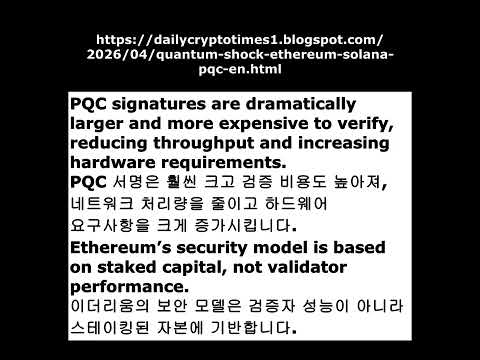
Watch the 50-second video to understand how PQC impacts Ethereum and Solana before diving into the full analysis below.
Quantum Shock: Can Ethereum and Solana Survive PQC?
As quantum computing advances faster than many expected, blockchain networks are entering a new era where their existing cryptographic foundations must be re‑examined. In particular, PoS (Proof‑of‑Stake) networks cannot avoid the structural shifts that post‑quantum cryptography (PQC) will bring — larger signatures, higher verification costs, and slower network propagation.
The crucial point is that not all PoS networks are affected in the same way. Even under the same PoS label, Ethereum and Solana differ fundamentally in their security foundations, validator architecture, and network design philosophy. These differences become far more visible in a PQC era.
The structural shock PQC brings to PoS networks
Post‑quantum signatures introduce several key changes compared to traditional schemes like ECDSA and Ed25519:
- Signatures become 20–40× larger: massive increase in block size, slower propagation, higher fork probability
- Verification costs increase: higher CPU and memory requirements, more pressure on validator hardware
- Network performance degrades: lower throughput (TPS), reduced block space efficiency
These changes directly impact the core pillars of PoS networks: security, performance, and decentralization.
Ethereum: Economic security and its interaction with PQC
Ethereum’s security is anchored in staked capital. In other words, even if network performance degrades, the security model itself can remain intact.
Expected changes under PQC:
- Larger signatures → slower block propagation, more variability in block times
- Higher verification costs → potential dropout of lower‑spec validators
- Increased block space pressure → possible reduction in L1 throughput
Why Ethereum is still relatively well‑positioned:
- Its security foundation is staked capital, not raw performance
- Lower hardware requirements make it easier to maintain validator decentralization
- Pipeline upgrades like Focil and ePBS can absorb part of the PQC overhead
- MEV/PBS mechanisms help stabilize incentives and network reliability
In short, even if PQC reduces Ethereum’s performance, it remains a network where the security model itself can still hold.
Solana: Execution‑based security and its collision with PQC
Solana’s security is built around high‑performance validator infrastructure. In this model, when network performance drops, security weakens alongside it.
Testnet experiments with post‑quantum signatures have already shown that when PQ signatures are applied, signature sizes grow by 20–40× and network performance can drop by around 90%. For a chain like Solana, designed around extreme throughput, this is a deeply alarming signal.
Challenges Solana faces under PQC:
- Larger signatures → bandwidth bottlenecks → sharp TPS decline
- Higher verification costs → even higher hardware requirements → fewer validators and more centralization pressure
- A design where performance degradation directly translates into weaker security
- Greater risk of network overload and downtime
Because Solana’s model effectively equates performance with security, PQC places a heavier burden on its core resource — high‑performance validators — and ultimately pressures both security and decentralization.
Ethereum vs. Solana under PQC: Performance degradation and security impact
Once PQ signatures are introduced, Ethereum and Solana — despite both being PoS networks — experience the shock in very different ways.
Impact of Larger Signatures
Ethereum: Slower block propagation, reduced throughput
Solana: Severe TPS drop, bandwidth bottlenecks
Increased Verification Costs
Ethereum: Some lower‑spec validators may drop out
Solana: Higher hardware bar → validator concentration
Security Impact
Ethereum: Economic security model remains intact
Solana: Performance loss directly weakens security
Adaptability
Ethereum: Pipeline upgrades (Focil/ePBS) can mitigate overhead
Solana: Structural burden is direct and clashes with design philosophy
Put in a single sentence: Ethereum can suffer performance degradation while still preserving its security model, whereas Solana faces a structural limitation where performance loss quickly becomes security loss.
Conclusion: Which PoS model is more adaptable in a PQC era?
PQC is not just a cryptographic swap‑out; it is a turning point that forces a redesign of blockchain security models from the ground up. Ethereum and Solana both use PoS, but the resource each chain treats as the root of security leads to very different levels of adaptability in a post‑quantum world.
- Ethereum: Capital‑based security → can preserve its security model even after PQC, with room to mitigate performance loss via pipeline improvements.
- Solana: Performance‑based security → PQC‑driven performance loss risks directly translating into weaker security and deeper centralization.
From this perspective, assuming a PQC future, Ethereum’s PoS security model appears more naturally and sustainably adaptable. The quantum era is not a distant theoretical threat; it is a practical variable that must be considered at the design level today. And the core question for any PoS network is this: how flexibly can its security philosophy absorb the shock of PQC?
Younchan Jung
Researcher exploring structural shifts in AI, blockchain, and the on‑chain economy.
If you would like to read this article in Korean, please click the button below.


댓글
댓글 쓰기