Michael Saylor’s Bitcoin Narrative: What’s Real and What’s Not
3-Point Summary
- Michael Saylor’s Bitcoin narrative is driven more by belief than by data or economic models.
- His claims on price outlook, institutional adoption, and government reserves often run ahead of reality.
- Despite exaggerated narratives, MicroStrategy has made meaningful contributions to Bitcoin’s legitimacy and infrastructure.

50-Second Shorts Video
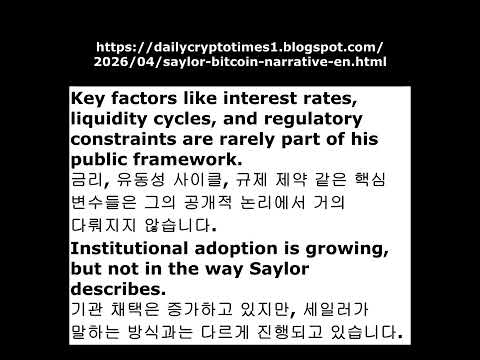
Watch the 50-second video to understand the key insights before diving into the full analysis below.
Michael Saylor’s Bitcoin Narrative: Five Claims and Their Limits
Michael Saylor is one of the most influential figures in the Bitcoin space. His statements strongly shape market sentiment, but he is also often criticized for repeating an overly exaggerated narrative. This article reviews five core elements of his Bitcoin narrative and offers a balanced assessment.
1) Bitcoin Price Outlook — A Belief-Driven Logic
Saylor frequently argues that Bitcoin is an asset that will “go up forever.” His reasoning is largely built on the following beliefs:
- Bitcoin is a digitally scarce asset with absolute supply limits.
- Over the long term, capital will migrate into Bitcoin from other assets.
- Fiat currencies inevitably lose purchasing power over time.
The issue is that this outlook is closer to a philosophical conviction than a data-driven price model. Key variables such as interest rates, liquidity, regulation, and volatility are barely incorporated. On top of that, MicroStrategy’s massive Bitcoin holdings create a clear conflict of interest: Saylor directly benefits if his bullish narrative pushes prices higher.
2) Institutional Adoption — A Story Ahead of Reality
Saylor often claims that:
- “Every company will eventually hold Bitcoin as a treasury asset.”
- “Big Tech companies will soon adopt Bitcoin.”
However, the current reality looks different:
- No major Big Tech firm (Apple, Amazon, Google, Microsoft, etc.) holds Bitcoin as a core treasury asset.
- U.S. GAAP accounting rules are unfavorable to holding Bitcoin on corporate balance sheets.
- Most institutional exposure to Bitcoin is via ETFs and other indirect vehicles, not direct balance-sheet holdings.
Institutional adoption is indeed an important trend, but it is not unfolding at the speed or scale Saylor often implies.
3) Government Reserves — A Gap Between Narrative and Policy
Saylor also argues that nation-states should accumulate Bitcoin as a strategic reserve asset, similar to gold.
- “Governments should hold Bitcoin as a strategic reserve.”
- “Countries that don’t hold Bitcoin will lose future competitiveness.”
In practice, however:
- No major country has officially adopted Bitcoin as a formal reserve asset.
- Central banks generally classify Bitcoin as a high-risk asset.
- Extreme price volatility conflicts with fiscal and financial stability objectives.
Saylor’s “national reserve” thesis is therefore less a realistic policy proposal and more a symbolic narrative to elevate Bitcoin’s status.
4) Common Problems Across These Three Claims
Across his price outlook, institutional adoption story, and government reserve thesis, several recurring issues appear:
- Belief over models — Philosophical conviction often outweighs economic, policy, or accounting frameworks.
- Conflict of interest — MicroStrategy’s large Bitcoin position means his public narrative is not neutral.
- Exaggerated expectations — His messaging can encourage investors to form unrealistic expectations.
- Underplaying constraints — Regulatory, accounting, and risk-management constraints are frequently downplayed or ignored.
His narrative is powerful for promoting Bitcoin, but it is not the same as a cold, objective analysis that investors can fully rely on.
5) MicroStrategy’s Positive Contributions to the Crypto Ecosystem
Despite these criticisms, MicroStrategy has undeniably contributed to the broader crypto ecosystem. A fair assessment must acknowledge both the limitations of Saylor’s narrative and the impact of his actions.
(1) Establishing Bitcoin as a Corporate Treasury Asset
MicroStrategy’s 2020 decision to allocate part of its treasury to Bitcoin sent a strong signal: “Public companies can consider Bitcoin as part of their financial strategy.” This move encouraged other firms to at least evaluate Bitcoin as a potential treasury asset.
(2) Improving Awareness and Legitimacy
Through countless interviews, conference talks, and reports, Saylor has consistently advocated for Bitcoin as a long-term asset. Even if some of his statements are exaggerated, he has contributed to raising awareness and shaping the public conversation around Bitcoin.
(3) Building Corporate-Grade Bitcoin Infrastructure
MicroStrategy did more than simply buy Bitcoin. It developed internal processes for custody, security, and treasury management tailored to holding Bitcoin at scale. This effectively created a practical reference model for other companies considering similar moves.
(4) Strengthening Long-Term Demand
By accumulating and holding Bitcoin with a long-term horizon, MicroStrategy has helped reduce short-term speculative float and contributed to a more structural demand base. This does not guarantee price appreciation, but it does influence the market’s maturity and depth.
(5) Acting as an Indirect Catalyst for the ETF Era
The fact that a listed company can hold Bitcoin on its balance sheet and communicate this transparently has influenced how regulators and traditional finance view Bitcoin. MicroStrategy’s example has served as indirect evidence of market maturity in the context of spot Bitcoin ETF approvals.
Conclusion: Separating Words from Actions
Michael Saylor’s narrative is often bold, optimistic, and at times clearly exaggerated. His views on price, institutional adoption, and government reserves frequently run ahead of current reality.
At the same time, MicroStrategy’s actions have had real and lasting impact on Bitcoin’s journey into the financial mainstream — from corporate treasury adoption to broader legitimacy and infrastructure development.
Investors and readers should separate these two layers: Saylor’s narrative can be a useful reference point, but it should not be followed blindly. A more robust approach combines his vision with data, regulation, risk, and institutional constraints. That is precisely the analytical stance that Daily Crypto Times aims to maintain.
Younchan Jung
Researcher exploring structural shifts in AI, blockchain, and the on‑chain economy.
If you would like to read this article in Korean, please click the button below.


댓글
댓글 쓰기