The $1.55 Quadrillion Stablecoin Era: How Blockchain Rails Must Evolve
3-Point Summary
- Stablecoin transaction volume will grow like an exploding number of railway passengers, requiring far more scalable blockchain rails.
- Arc, Ethereum, and emerging institutional/enterprise chains evolve into a multi-layer rail system handling payments, settlement, and national-scale infrastructure.
- By 2035, stablecoin volume reaches $1.55 quadrillion, enabled by new high-speed blockchain rails built before demand fully arrives.

50-Second Shorts Video
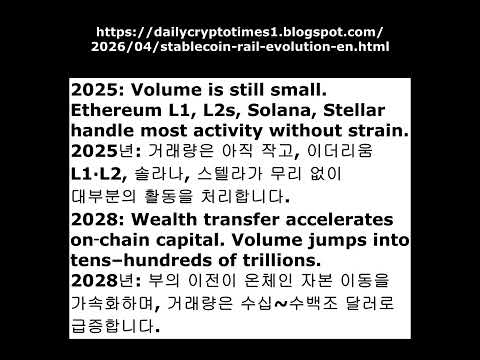
Watch the 50-second video to understand the stablecoin volume explosion before diving into the full analysis below.
How Far Can Stablecoin Volume Grow?
The Evolution of Blockchain Rails from 2025 to 2035
Stablecoins are becoming core infrastructure for global payments, settlement, remittances, and tokenization (RWA).
In this context, stablecoin transaction volume is like the growing number of passengers on a railway system,
and blockchain networks are the rails that must carry those passengers safely and efficiently.
Over the next decade, passenger numbers will grow exponentially, and the rails will need to expand accordingly.
This post explores how stablecoin volume and blockchain rails evolve from 2025 to 2035.
■ 2025 — Around $2T: Early Stage Where Existing Rails Are Enough
In 2025, the number of passengers (transactions) is still low enough for existing rails to handle comfortably.
Network load is manageable, and the main focus is using the current infrastructure efficiently.
A. Volume
– Around $2T (adjusted volume)
B. Network structure
– Ethereum L1: high-value settlement
– L2 (Arbitrum, Base, etc.): high-throughput transactions
– Solana, Stellar: low-cost, high-speed payments
– Early on-chain settlement by players like Visa and PayPal
■ 2028 — Wealth Transfer Begins: When Passenger Numbers Start to Surge
By 2028, a major generational wealth transfer drives a rapid increase in passengers.
More capital moves on-chain, and the need to expand the rails becomes clear.
A. Volume
– Expands into the tens to hundreds of trillions of dollars
B. Network structure
– Emergence of institution-grade public chains
– Acceleration of RWA + stablecoin integration
– Possible mainnet launch of Arc (USDC-focused L1)
Arc begins to establish itself as a dedicated L1 for payments.
■ 2032 — Reaching Visa Scale: The Onset of Rail Saturation
By 2032, stablecoin payments reach annual volumes comparable to Visa.
POS (Point of Sale) traffic moves on-chain, and existing rails start to hit capacity limits.
A. Volume
– In the hundreds of trillions of dollars
B. Network structure
– Arc: operating in earnest as a global payment layer
– Ethereum: focused on high-value settlement and institutional flows as an L1
– Visa, Mastercard, Stripe and other payment processors join as validators on Arc
Arc functions as an independent L1 that directly processes everyday payments,
while Ethereum serves as a parallel L1 dedicated to high-value settlement.
■ 2035 — $1.55 Quadrillion: A High-Speed Rail Network for Massive Passenger Flows
By 2035, stablecoin transaction volume reaches about $1.55 quadrillion.
At this scale, the old railway network is no longer sufficient; a true high-speed rail system is required.
A. Volume
– Baseline: $719T
– Wealth transfer: +$508T
– Payment saturation: +$232T
– Total: about $1.55 quadrillion
B. Network structure
– Arc = primary global POS payment layer (L1)
– Ethereum = core L1 for global settlement, RWA, and institutional transactions
– Emergence of public chains with participation from states and central banks
– Proliferation of enterprise L2s and appchains
Arc becomes the high-speed rail that carries everyday payments,
Ethereum acts as the central hub for cross-border and institutional settlement,
and L2s/appchains serve as branch lines built on top of Ethereum.
■ Blockchain Evolution to Handle Exploding Transaction Volume
Once stablecoin volume exceeds $10T, blockchain infrastructure begins to reorganize along clear functional lines.
1) Arc = High-speed rail (L1 for everyday payments)
– Directly processes POS, small-value, and high-frequency payments
– Handles millions to tens of millions of transactions per second
– Sub-second finality
– Global payment processors participate as validators
2) Ethereum = Central station (L1 for settlement and institutional flows)
– Settlement layer for states, institutions, RWA, and large-value finance
– Final settlement hub for L2s and appchains
– Operates in parallel with Arc, with clearly separated roles
3) Public chains with state and central bank participation
– Interoperability between CBDCs and stablecoins
– Regulators and public institutions join as validators
– National financial infrastructure moves on-chain
4) Expansion of enterprise L2s and appchains
– Banks, payment companies, and fintechs run their own L2s
– Interoperate with Ethereum
– Function as dedicated branch lines for specific enterprises
■ Conclusion: Rails Are Laid Before the Passengers Arrive
Today’s blockchain rails cannot handle $1.5 quadrillion in annual volume.
But this future is still plausible because new rails—Arc, institution-grade L1s, and enterprise L2s—are built
before stablecoin volume explodes to that level.
By 2035, the stablecoin ecosystem will have evolved into a
new global payment infrastructure that goes far beyond the limits of today’s blockchains.
Younchan Jung
Researcher exploring structural shifts in AI, blockchain, and the on‑chain economy.
If you would like to read this article in Korean, please click the button below.


댓글
댓글 쓰기