Korea’s STO Has Opened, But the Real Key to the Market Lies Elsewhere
3-Point Summary
- STO has been legalized, but the Basic Act and core infrastructure remain incomplete.
- Japan is moving ahead with a phased approach to regulation, infrastructure, and market structure.
- Korea’s next five years hinge on completing the Basic Act and building market-driven infrastructure.

50-Second Shorts Video
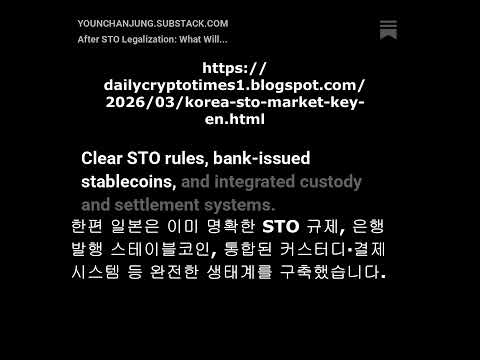
Watch the 50-second video to grasp the overall flow before diving deeper into the full analysis below.
EN After STO Legalization: What Will Truly Move Korea’s Digital Asset Market?
In January 2026, Korea’s digital asset market reached a critical turning point. The STO (Security Token Offering) bill passed the National Assembly, opening the door to capital market digitalization. Yet the broader Digital Asset Basic Act (Phase 2), which should govern the entire market, remains unfinished.
This article examines Korea’s regulatory landscape through the following structure: (1) Meaning of the STO bill → (2) Delay of the Digital Asset Basic Act → (3) Uncertain STO implementation (vs. Japan) → (4) Core issues to resolve (vs. Japan) → (5) Market-led infrastructure strategy (vs. Japan).
1. The Meaning of Korea’s STO Bill (Passed January 2026)
Through amendments to the Capital Markets Act and the Electronic Securities Act, Korea has officially recognized the issuance and trading of distributed-ledger-based securities. STO is no longer an experimental technology but a fully recognized financial product.
- Bringing Real World Asset (RWA) tokenization (real estate, art, livestock, etc.) into the regulated market
- Resolving legal uncertainty around fractional investment platforms
- Connecting traditional capital markets with digital, token-based securities markets
- Ongoing work on detailed rules, with full implementation targeted for 2027
Korea’s capital market has effectively entered a full-scale digital transformation phase.
2. Delay of Korea’s Digital Asset Basic Act (Phase 2): Causes and Risks
Causes of Delay
- Debate over the issuer of KRW stablecoins (bank-centric vs. open to private sector)
- Very broad regulatory scope: stablecoins, custody, wallets, service providers
- Tension between financial stability and industry promotion as policy goals
Key Risks
- Regulatory vacuum for non-securities digital assets such as CEX (Centralized Exchange), custody, and wallets
- Incomplete investor protection framework
- Risk of Korea falling behind as global regulatory frameworks advance
3. Uncertain STO Implementation in Korea — Compared with Japan
Korea has passed the STO bill, but the foundations needed for real-world operation are still lacking. Japan, by contrast, has gradually established clear rules for STO, RWA, and stablecoins, enabling more stable market operation.
Korea
- Clearing, settlement, and custody infrastructure remains undefined due to the absence of a basic law
- Financial institutions and fintechs struggle to finalize STO platform business models
- STO risks becoming a “half-implemented” regime with legal basis but limited real functionality
Japan
- Since the early 2020s, Japan has clarified rules for STO, electronic securities, and trust-based tokens
- Built a stable clearing and custody framework centered on banks and securities firms
- 2023 legal reforms established a bank/trust-company stablecoin issuance model
→ Japan has aligned regulation, infrastructure, and market structure, while Korea has passed the law first but left the rest behind.
4. Two Core Issues Korea’s Digital Asset Market Must Resolve
— Viewed Through Comparison with Japan
4-1. Incomplete Clearing, Settlement, and Custody Infrastructure
Korea can now issue and trade STOs, but the systems that make them truly work — stablecoins, custody, wallets, and settlement infrastructure — are still incomplete.
Japan Comparison
- Japan has already built bank/trust-based custody and settlement frameworks
- Stablecoin issuers are clearly defined, supporting market stability
→ Korea needs similar standardization of infrastructure led by financial institutions.
4-2. Incomplete Digital Asset Basic Act
In Korea, rules for non-securities digital assets — CEX, custody, wallets, stablecoins — remain underdeveloped. As a result, it is effectively impossible to build integrated services linking STOs and non-securities digital assets.
Japan Comparison
- Japan moved early to regulate virtual asset service providers (VASP)
- Clear rules on listing, asset segregation, and custody underpin investor protection
- High connectivity between STO, CEX, and RWA markets
→ Korea must use the Digital Asset Basic Act to create a coherent, market-wide regulatory framework, as Japan has done.
5. Market-Led Infrastructure Strategy for Korea
— Lessons from Japan’s Phased Model
Korea’s digital asset market now faces two decisive questions:
- After STO legalization, can the Digital Asset Basic Act truly connect the entire market?
- How can stablecoin, custody, wallet, and settlement infrastructure be built in a market-led way?
Possible strategic directions for Korea include:
- Stablecoins: Reference Japan’s bank/trust-centric model, while adopting a hybrid approach that allows broader private-sector participation
- Custody and wallets: Build joint infrastructure combining the credibility of financial institutions with the technology of blockchain firms
- Settlement systems: Learn from Japan’s phased expansion, but aim for an open settlement network connecting STO, RWA, and CEX in Korea
✨ Conclusion
Korea’s STO bill has opened the door to digital financial innovation. However, without both a robust Digital Asset Basic Act and market-ready infrastructure, the STO market cannot function in a fully effective way.
Japan’s experience offers a clear lesson: only when regulation, infrastructure, and market structure evolve together can the STO market truly grow.
Ultimately, the next five years of Korea’s digital asset market will be shaped by two questions:
- “After STO legalization, can the Digital Asset Basic Act connect the entire market?”
- “How will stablecoin, custody, wallet, and settlement infrastructure be built in a market-led way?”
Daily Crypto Times will continue to follow how Korea answers these questions.
Younchan Jung
Researcher exploring structural shifts in AI, blockchain, and the on‑chain economy.
If you would like to read this article in Korean, please click the button below.


댓글
댓글 쓰기