Finance vs. the Crypto Industry: The ‘Public vs. Permissioned’ Battle Over the Rails of Tokenized Stocks
3-Point Summary
- The core conflict is between traditional finance’s preference for permissioned blockchains and the crypto industry’s push for open public blockchain rails.
- Tokenized stocks highlight a fundamental divide: regulated, institution‑controlled infrastructure vs. open, globally accessible on-chain liquidity.
- The choice between public and permissioned rails will determine who shapes the future standard of financial infrastructure.

50-Second Shorts Video
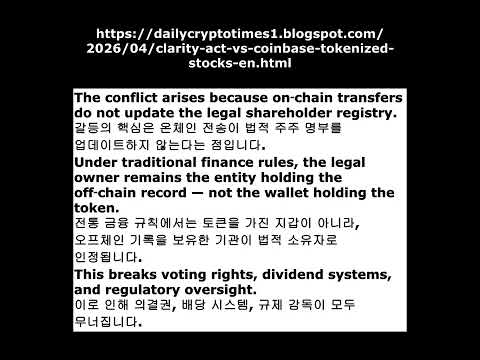
Watch the 50-second video to see how tokenized stocks are reshaping the battle between public and permissioned blockchains before diving into the full analysis below.
Introduction: Why Tokenized Stocks Matter Now
The defining keyword of the digital asset market in 2026 is undoubtedly tokenization. As traditional financial assets—stocks, bonds, real estate, and funds—begin moving on-chain at scale, the central question has become: who will set the rules for this new financial infrastructure?
At the center of this debate is the CLARITY Act, a pivotal bill that will shape the direction of U.S. digital asset regulation. The Act directly conflicts with Coinbase’s vision for an on-chain superapp, as it strictly defines the blockchain rails on which tokenized stocks may operate.
The core issue is whether tokenized stocks should run on permissioned blockchain networks operated by regulated financial institutions, or on public blockchains like Ethereum and Solana.
- The CLARITY Act allows trading of tokenized stocks only on permissioned blockchains operated by regulated financial institutions, explicitly prohibiting free transfers or swaps on public blockchains.
- Coinbase, on the other hand, envisions tokenized stocks moving freely on public blockchains with open liquidity and global accessibility.
Ultimately, the future of tokenized stocks hinges on a battle between a closed, institution‑controlled on-chain infrastructure and an open, public blockchain–based global liquidity network.
This article compares three key areas:
- The tokenized stock model defined by the CLARITY Act
- The on-chain stock model envisioned by Coinbase
- Why these two models fundamentally collide
1. Tokenized Stock Issuance Under the CLARITY Act
The CLARITY Act treats tokenized stocks as digital versions of traditional securities. Even when moved on-chain, they remain fully subject to existing securities regulations.
- Issuer (the original company) approval required
- SEC registration, disclosures, and audits required
- Issuance only by registered broker‑dealers or financial institutions
- Tokens classified as legal securities
Summary: “Digital securities with the same rules as traditional stocks.”
2. Tokenized Stock Trading Under the CLARITY Act
Trading is restricted to regulated financial environments.
- Trading allowed only on permissioned blockchains operated by regulated financial institutions
- No free transfers or swaps on public blockchains like Ethereum or Solana
- KYC/AML required
- Wallet‑to‑wallet transfers restricted
- Dividends, voting rights, and corporate actions follow traditional rules
Summary: “On‑chain trading allowed, but free movement is not.”
3. Coinbase’s Vision for Tokenized Stock Issuance
Coinbase aims to build an open, on-chain global asset market with minimal reliance on traditional financial regulation.
- No issuer approval required
- No SEC registration for on-chain stock issuance
- Issuance by Coinbase or partner entities
- Tokens treated as on-chain assets, not securities
Summary: “A Web3-style market where anyone can issue on-chain stocks.”
4. Coinbase’s Vision for Tokenized Stock Trading
Coinbase imagines a world where stocks move like crypto assets on public blockchains.
- 24/7 global trading
- Instant stock ↔ crypto swaps
- Free wallet‑to‑wallet transfers
- Trading through on-chain liquidity pools
- Instant settlement (finality)
Summary: “Stocks move freely between wallets and trade like crypto.”
5. Why Coinbase’s Model Conflicts With Traditional Finance
The core issue is that on-chain ownership does not equal legal ownership under traditional financial law.
Traditional Finance: Centralized Ownership Records
Legal ownership is determined by centralized registries maintained by transfer agents, the DTCC, and the issuing company. In other words, the legal shareholder is defined off-chain.
Coinbase’s Model: Only the On-Chain Ledger Changes
When tokens move between wallets, only the on-chain record changes. The official shareholder registry does not.
Thus, on-chain holder ≠ legal shareholder.
Coinbase or its partners retain legal ownership of the underlying stock, while users hold only a tokenized representation—not legal shares.
Why Regulators Object
- Companies cannot identify their real shareholders
- Voting rights and dividend systems break down
- Stocks move like crypto without AML/KYC controls
- Potential to bypass securities regulation entirely
Summary: “Because the legal shareholder registry does not change, Coinbase’s model conflicts with securities law.”
Conclusion
The conflict between the traditional financial sector and the crypto industry is not a simple regulatory disagreement. It is a structural battle over who will define the standard for future financial infrastructure.
- Traditional Finance: Prefers permissioned blockchains that preserve existing regulatory frameworks
- Crypto Industry: Favors open, public blockchain rails that enable free asset movement and global on-chain liquidity
With fundamentally different philosophies, technologies, and regulatory frameworks, a clash between the two models is inevitable.
As tokenized stocks become a core asset class in future markets, the choice between public and permissioned rails will play a decisive role in shaping the future financial order.
Younchan Jung
Researcher exploring structural shifts in AI, blockchain, and the on‑chain economy.
If you would like to read this article in Korean, please click the button below.


댓글
댓글 쓰기